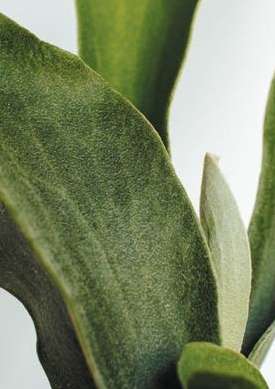
Ferns lend a room fine texture and arching foliage. Palms provide a more architectural, tropical outline. Both groups can make a collection feel fuller when placed where their light and moisture needs are met.
Elkhorn fern
The distinctive fronds resemble antlers. Display it where the shape can be seen clearly, with room around its leaves.
Care: Bright indirect light; maintain suitable moisture and airflow.
Boston fern
Long, arching fronds make this a natural choice for a shelf or hanging planter. It can also suit a bright bathroom with adequate humidity.
Care: Indirect light; keep the mix evenly moist but not waterlogged.
Brake fern
The narrow, ribbon-like fronds rise and arch over a dense base, creating a lighter silhouette than broad-leaved houseplants.
Care: Indirect light; regular moisture; well-drained mix.
Bear’s paw fern
Broader fronds and visible, fuzzy rhizomes give this fern its unusual character.
Care: Indirect light; moderate moisture and humidity.
Maidenhair fern
Delicate leaflets on slender stems create a soft, airy texture. Consistent conditions matter more for this species than for a tough ZZ plant.
Care: Bright indirect light; steady moisture and higher humidity.
Rhapis palm
Also called lady palm, this clumping palm has fan-shaped leaves and fibrous stems that lend structure without dominating a room.
Care: Bright indirect light; moderate watering; drainage.
Chinese fan palm
The broad, fan-shaped fronds bring a strong architectural form to a warm indoor space.
Care: Bright indirect light; moderate watering and a well-drained mix.
Kentia palm
This slow-growing palm is prized for graceful fronds and a calm, upright habit. Give it time and sufficient space to mature.
Care: Bright indirect light; moderate watering; good drainage.
Ferns generally need closer attention to moisture and humidity than palms. Keep both groups away from abrupt heat or cold and check their containers before watering.