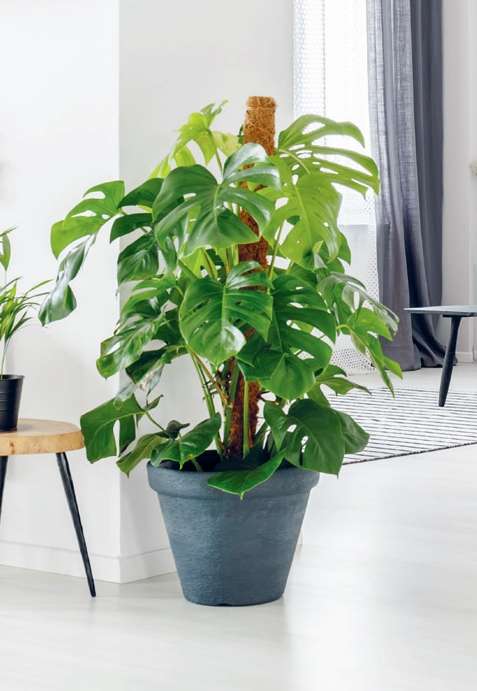
A large plant changes the scale of a room. Before buying one, measure the available height and width, look at the light over a full day, and consider whether you can move the pot for cleaning and repotting. These species offer different shapes, from braided stems to broad divided leaves.
Money tree
Pachira aquatica is often sold with braided trunks and a canopy of palmate leaves. It suits a bright room where the leaves have space to spread. Give it bright indirect light and a draining mix. Water thoroughly after the upper mix dries, then empty the saucer.
Dwarf umbrella tree
Schefflera arboricola carries leaflets around each stalk like an open umbrella. Regular pruning can keep a young plant compact. Place it in bright filtered light and water when the top of the pot has dried. Turn the container for balanced growth.
Fiddle-leaf fig
Large violin-shaped leaves make this ficus a strong focal point. It may react to abrupt changes in light, temperature or watering. Choose a bright indirect position and keep it reasonably stable. Water after the upper mix dries, drain completely, and wipe broad leaves to remove dust.
Meyer lemon
A compact citrus can bring fragrant flowers and fruit to a very bright indoor space. It needs much more sun than most foliage houseplants. Place it at the sunniest suitable window and move it outdoors gradually in warm weather if possible. Keep watering regular, feed during active growth, and inspect for scale or mealybugs.
Monstera
Mature Monstera deliciosa develops large split leaves and a spreading or climbing habit. It needs room and a support as it grows. Use bright indirect light and water after the top few centimeters dry. Secure aerial roots or a support gently rather than forcing stiff stems.
Norfolk Island pine
Araucaria heterophylla is an evergreen with tiers of soft-looking branches. It is often sold as a small holiday tree but can grow far larger. Give it bright light, an evenly moist but draining mix, and protection from hot dry air or sudden cold drafts.
Ponytail palm
Beaucarnea recurvata is not a true palm. Its swollen base stores water beneath a fountain of narrow leaves. Provide strong light and a fast-draining mix. Let the pot dry well between waterings; a large wet pot is a greater risk than a short dry period.
Rubber plant
Ficus elastica has thick glossy leaves and an upright habit. It can be easier to accommodate than a fiddle-leaf fig, but it still benefits from a stable location. Give it bright indirect light, water after partial drying, and keep the leaves clean. The milky sap can irritate skin.
Split-leaf philodendron
The deeply cut leaves of Thaumatophyllum bipinnatifidum, often sold under its former Philodendron name, make a wide sculptural plant. Allow room around its foliage, provide bright filtered light, and water when the upper mix begins to dry. Support the heavy pot so it cannot tip.
Large plants are long-term companions. Choose a container with drainage and a size that matches the root ball, then make gradual changes as the plant grows.