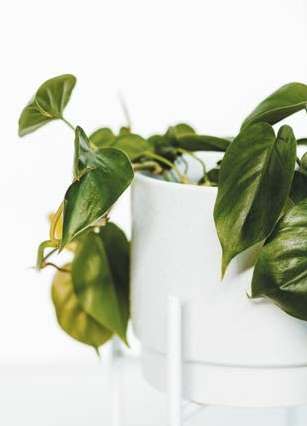
Philodendrons range from trailing vines to broad, self-heading plants. Ficus species often become the room’s main indoor tree. Their different habits make it easy to build height, depth and movement into a display.
Heartleaf philodendron
Heart-shaped leaves trail from shelves or climb a support. Pinching a growing tip can encourage fuller growth, and a healthy cutting can root from a node.
Care: Bright indirect light; moderate watering; free-draining mix.
Rojo Congo
Young leaves emerge deep red before turning green. Its upright, non-vining habit works well where a trailing plant would not.
Care: Bright indirect light; moderate to low watering; drainage.
Xanadu
This compact, wide-growing philodendron fills an open area with deeply divided foliage. Keep it away from pets that may chew the leaves.
Care: Bright indirect light; moderate watering; free-draining mix.
Fiddle-leaf fig
The large fiddle-shaped leaves make a striking indoor tree, but the plant dislikes abrupt changes. Turn the pot periodically for balanced growth.
Care: Bright indirect light; water when the upper few centimeters dry; drain fully.
Sabre fig
Its narrow leaves create a lighter outline than a fiddle-leaf fig and can recall the form of eucalyptus foliage.
Care: Bright indirect light; moderate watering; well-drained mix.
Rubber plant
Thick, glossy leaves and a sturdy upright habit make this one of the most versatile indoor figs. Variegated forms usually need brighter conditions to keep their markings.
Care: Bright indirect light; moderate watering; drainage.
Choose a specimen that fits the available space, then keep its light and watering reasonably consistent. Dust broad leaves so they can receive light and so pests are easier to spot.